From a quoting MVP to a production ops system for exterior cleaning companies
Slow estimates and scattered follow-up were losing exterior cleaning companies the job.
Quote on-site, on a phone, in minutes — then grow into CRM, payments, and neighborhood lead gen without a rewrite.
A live production platform at quotesnapai.com. Scope grew with the business, not against the architecture.
Problem
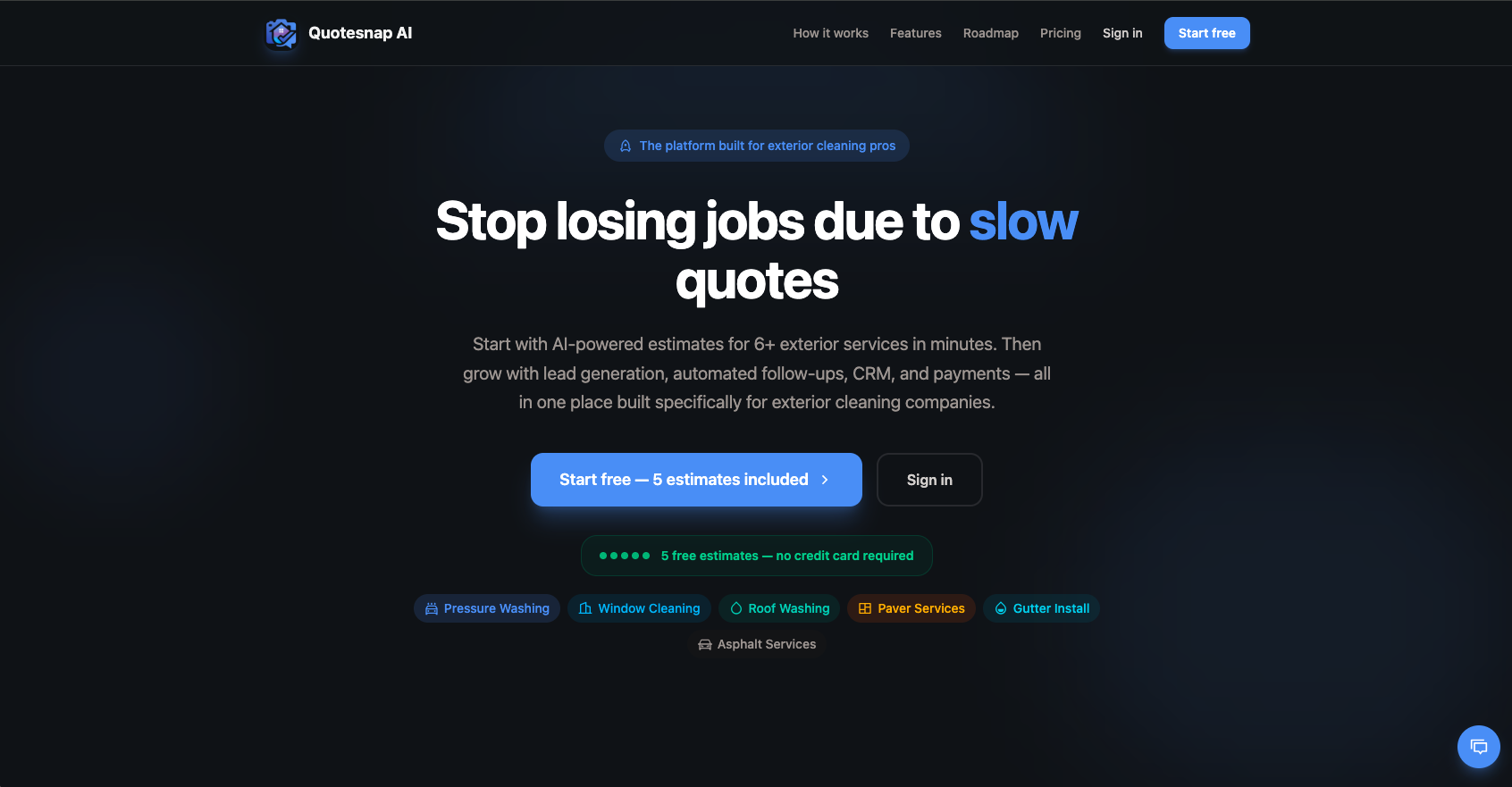
Exterior cleaning companies — pressure washing, window cleaning, roof washing, gutters, pavers, asphalt — were losing work because the quote took too long. A contractor would visit a property, guess a price later, text a number, and hope the homeowner was still waiting.
Follow-up lived in personal phones. Payments lived in another tool. There was no clean way to turn one completed job into the next ten houses on the same street. The original ask was an MVP that could produce a professional estimate fast enough to send before leaving the driveway.
Constraints
- Mobile-first: quoting happens on site, often on a single phone, with poor signal and impatient customers.
- Service-specific pricing: a window-cleaning job and a roof-wash job do not share the same inputs.
- Property data is messy: addresses, lot shapes, and satellite context rarely arrive as a clean record.
- The product had to start as an estimating tool and later absorb CRM, payments, SMS/email, admin, and affiliates without throwing the MVP away.
Architecture
Estimating is the core. Maps, payments, CRM, messaging, and affiliates attach to the quote, not the other way around.
Decisions
We treated quoting as the revenue bottleneck and everything else as a consequence of a sent quote. AI assists the estimate — photos and service-specific formulas — but the contractor still owns the price. That kept trust with a trade audience that will not accept a black-box number.
Maps and property data were designed in from the start, even when the first release only needed an address. The growth loop (“one job into the neighborhood”) depends on location, so bolting maps on later would have been expensive. Admin, payments, and affiliates were built as modules on the same quote record rather than as separate products.
Implementation
- AI estimating. Service templates for six-plus exterior jobs, photo upload, and pricing formulas that produce a sendable quote in minutes.
- Maps and property data. Job location, surrounding properties, and the data quality problems that come with incomplete parcels and mismatched photos vs. addresses.
- Quote delivery. Professional quote pages plus SMS and email so the homeowner can accept without another phone call.
- Payments. Collect and invoice from the same quote, instead of sending people to a separate processor with no context.
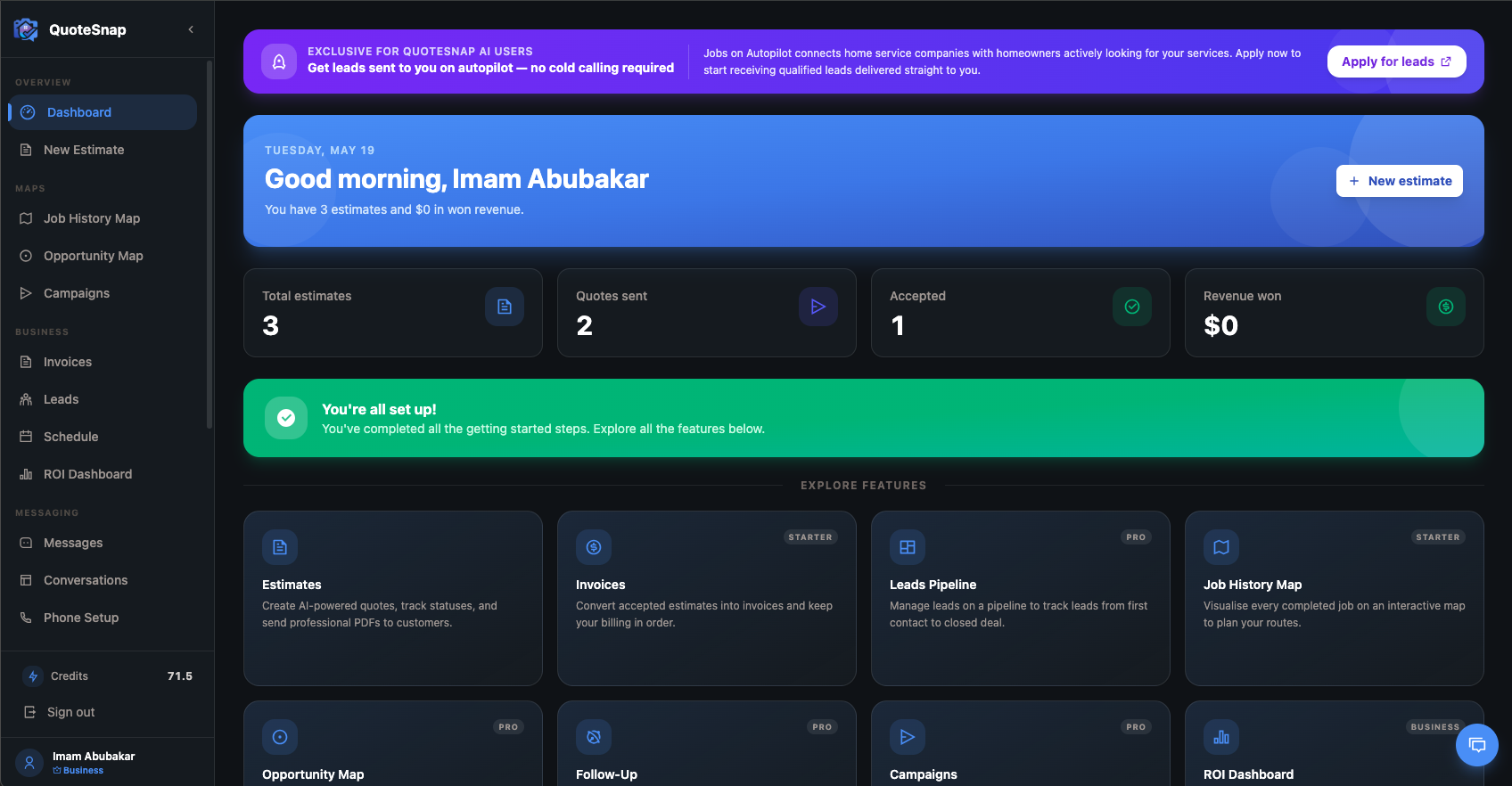
- Admin and CRM. Pipeline, follow-up automation, and an operations view that replaced scattered texts.
- Affiliate architecture. Referral and partner paths that sit on top of quoting rather than inside it, so growth experiments did not destabilize estimates.
Scope evolved in public: first estimates, then delivery, then CRM and payments, then neighborhood lead gen. The architecture held because the quote remained the system’s source of truth.
Results
Quotesnap AI is a live production product. Contractors generate estimates on site, send them immediately, and run follow-up, payments, and operations from one platform instead of a pile of tools. Confidential commercial details stay with the client; the public result is a system people actually use to sell work.
Lessons
- AI is only valuable when it sits inside the job the user already has to do — here, producing a price before leaving the property.
- Property data is a product problem, not a map widget. Incomplete records and messy addresses will leak into every later feature if you ignore them.
- An MVP that ships the bottleneck creates pull for CRM, payments, and affiliates. Those should attach to the same record, not start as new apps.